Best Transit Hotels in the US: The 2026 Definitive Logistics Guide
In the high-velocity landscape of contemporary North American aviation, the traditional boundary between the terminal and the hotel has largely dissolved. For the ultra-long-haul traveler or the professional navigating a transcontinental hub-and-spoke system, the transit hotel is no longer a secondary luxury; it is a critical component of flight logistics. As we move through 2026, the American hospitality sector has seen a radical transformation in “Short-Interval Lodging,” where the value of a property is measured not in square footage or aesthetic opulence, but in “Temporal Efficiency”—the speed at which a passenger can move from a jet bridge to a horizontal resting state.
The United States presents a unique challenge in the transit hotel sector due to its rigid regulatory environment regarding “Airside” versus “Landside” access. Unlike major international hubs in the Middle East or Southeast Asia, where passengers can often check into a room without clearing customs, the American model is predominantly landside. This requires travelers to navigate immigration, customs, and security cordons before accessing the most prestigious properties. Consequently, a definitive analysis of the market must go beyond a list of amenities to examine the “Logistical Friction” inherent in each hub, from the automated people movers of Chicago O’Hare to the subterranean connectors of Denver International.
To identify the premier options, one must apply a rigorous editorial lens to the concepts of acoustic engineering, metabolic recovery, and digital integration. A “best” hotel in this category must survive the scrutiny of a three-hour delay, a missed connection, and the physiological toll of multiple time-zone shifts. It is an infrastructure that must operate with the precision of an air traffic control tower while providing the sensory insulation of a private sanctuary. This article deconstructs the current state of American airport hospitality, establishing a framework for evaluating properties that serve as the vital connective tissue of global mobility.
Understanding “best transit hotels in the US.”
A sophisticated evaluation of the best transit hotels in the US requires a departure from standard hospitality metrics. In a transit context, “luxury” is redefined as the absence of noise and the presence of direct terminal access. A common misunderstanding among domestic travelers is the conflation of “Airport Area Hotels” with “Terminal-Integrated Hotels.” A property located two miles from the runway, dependent on a shuttle bus with a twenty-minute headway, is fundamentally different from a property like the TWA Hotel at JFK or the Westin at Denver International, where the lobby is a physical extension of the security perimeter. The former is a lodging solution; the latter is a navigational asset.
Oversimplification risks often manifest in the neglect of “Acoustic Integrity.” The physical proximity of a hotel to an active runway—while desirable for speed—introduces a high risk of “Vibrational Fatigue.” The top-tier properties in the U.S. utilize triple-pane specialized glazing and decoupled structural slabs to ensure that the roar of a GE9X engine at takeoff does not translate into a guest’s sleep cycle. When analyzing these hotels, one must look past the thread count of the linens and investigate the “STC” (Sound Transmission Class) ratings of the building envelope. A failure in acoustic governance renders all other premium amenities irrelevant for the transit-weary traveler.
Furthermore, a multi-perspective explanation must account for “Jurisdictional Logistics.” Because the U.S. lacks a widespread airside hotel system, the “best” properties are those that have successfully integrated with the TSA PreCheck and Clear ecosystems. For an international passenger arriving from London or Tokyo, the transit hotel experience is inextricably linked to the efficiency of the Customs and Border Protection (CBP) facility at that specific airport. Therefore, evaluating a hotel involves evaluating the hub itself—Dulles (IAD) may offer different transit efficiencies than San Francisco (SFO), regardless of the brand name on the hotel door.
Deep Contextual Background: The Evolution of Hub Residency
The history of airport lodging in the United States is a narrative of increasing integration. In the 1960s and 70s, airport hotels were “Motor Inns” situated on the outskirts of the airfield, designed for the emerging demographic of traveling salesmen and families on layovers. They were utilitarian, isolated, and culturally detached from the aviation experience. The turning point arrived with the “Aerotropolis” concept—a reimagining of the airport as a central business district. This shift demanded that hospitality move from the perimeter to the core.
By 2026, the “Second Generation” of integrated hotels has taken hold. These properties are no longer just places to sleep; they are “Productivity Nodes.” The TWA Hotel at JFK serves as the quintessential example of this evolution—a historic preservation project that turned Eero Saarinen’s iconic terminal into a flagship destination. Simultaneously, brands like Hyatt and Marriott have begun “Bespoke Hub Engineering,” designing hotels specifically for the Dallas-Fort Worth (DFW) and Orlando (MCO) layouts. This industrial evolution reflects a broader trend: the flight is no longer seen as the “event,” but rather the transition between two highly managed environments, with the transit hotel serving as the stabilizing anchor.
Conceptual Frameworks and Mental Models
1. The “Walking-Velocity” Model
This framework posits that the value of a transit hotel is inversely proportional to the number of “Modality Shifts” required to reach the bed. A property requiring a train and a bus is of lower value than one requiring only an elevator. In the U.S. market, “Zero-Modality” properties are the gold standard.
2. The “Circadian Alignment” Framework
A mental model for assessing a hotel’s ability to facilitate “Bio-Hacking.” The best properties offer specialized lighting (CRI-managed), “Blackout Integrity” (no light leakage at the door or window), and “Metabolic Flexibility” (24-hour high-quality protein access).
3. The “Temporal Arbitrage” Strategy
This framework views the hotel cost not as an expense, but as a purchase of time. If a terminal-integrated hotel costs $100 more than a shuttle-access hotel but saves 90 minutes of transit time, the traveler is “buying back” their time at a rate of $1.11 per minute—a bargain for high-value professionals.
Key Categories: Mapping the American Transit Footprint
The U.S. market is divided into distinct operational tiers, each with a specific trade-off profile.
Realistic Decision Logic: The “L-Zone” Audit
When choosing from the best transit hotels in the US, the traveler should perform an “L-Zone” (Landside Zone) audit. If your connection is international-to-international, you must have a visa to enter the U.S. and access these hotels. If you lack the credentials to clear customs, even the most integrated hotel is inaccessible, forcing a fallback to airside “Minute Suites” or lounge facilities.
Detailed Real-World Scenarios
The “Polar-Route” Recovery in Chicago (ORD)
A traveler arrives from Hong Kong at 5:00 AM with a 10-hour layover before a flight to Miami.
-
The Conflict: Intense jet lag meets a high-congestion terminal environment.
-
The Solution: The Hilton Chicago O’Hare. Located directly across from Terminals 1, 2, and 3 via subterranean walkways.
-
The Result: By avoiding the “Blue Line” or shuttle buses, the traveler gains two extra hours of REM sleep, neutralizing the “Jet Lag Hangover” before the final leg.
The “Tech-Layover” in San Francisco (SFO)
A consultant has an 8:00 PM arrival and a 7:00 AM departure.
-
The Constraint: Extreme time-sensitivity.
-
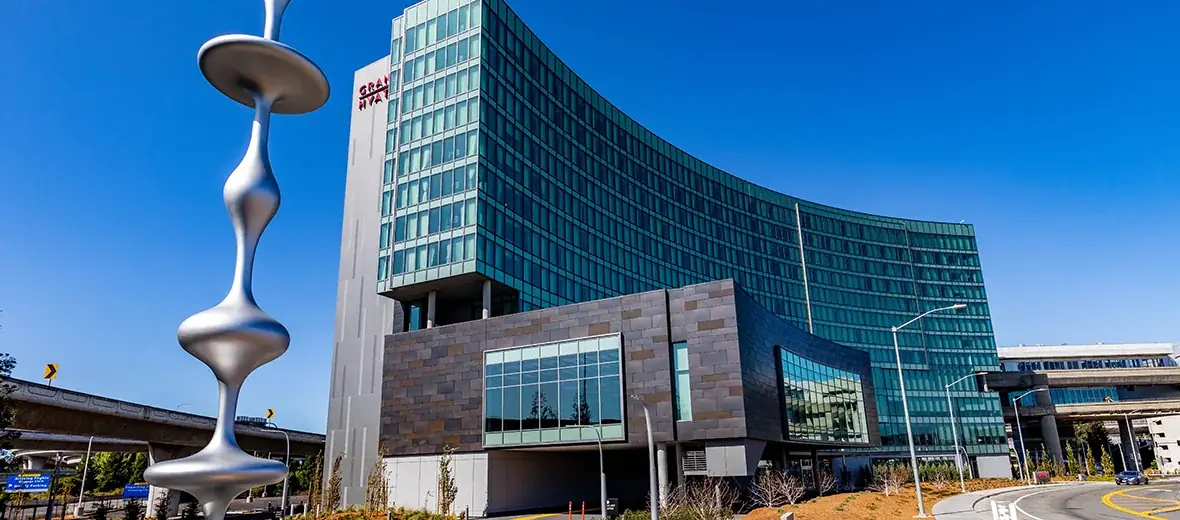
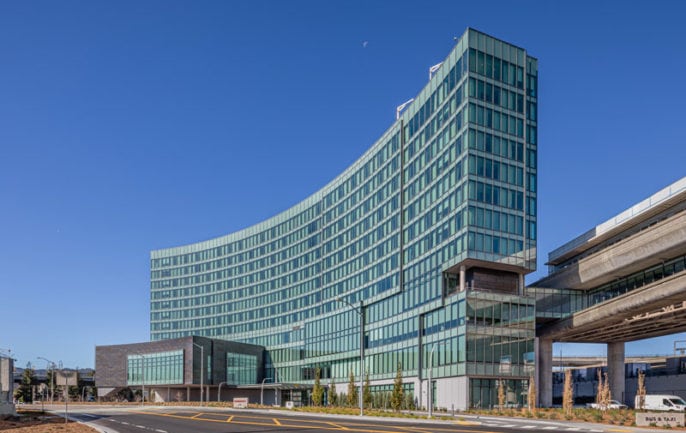
The Solution: Grand Hyatt at SFO. Access via the AirTrain “Hotel Station.”
-
The Result: The “Digital Check-in” allows the traveler to go from the AirTrain to the room in under four minutes, maximizing the sleep window in a high-STC environment.
Planning, Cost, and Resource Dynamics
The economics of transit hotels are notoriously volatile, driven by “Day-Rate” availability and terminal congestion.
Range-Based Authorization
For corporate travelers, authorize a 25% premium above standard city rates for terminal-integrated properties. The “Indirect Savings” in reduced taxi/Uber costs and the elimination of “Missed-Connection Risk” almost always offset the higher room rate.
Tools, Strategies, and Support Systems
-
“Dead-Zone” Verification: Use acoustic-mapping apps to check user-submitted decibel levels for rooms facing the tarmac.
-
Mobile-Key Redundancy: Always download the hotel’s app before landing. In high-velocity transit, the 10-minute wait at a reception desk is a “Systemic Failure.”
-
The “Gym-Shower” Pivot: If a room is not ready, many top-tier U.S. transit hotels (like the Westin DFW) allow access to the fitness center showers for a nominal fee.
-
Luggage-Bridge Services: High-end transit hotels often offer a service where bags are transferred directly from the hotel to the airline’s baggage system (available at select hubs).
-
Biometric Check-in: Properties are increasingly integrating with CLEAR to verify identity, bypassing the “Passport-at-Desk” bottleneck.
-
24-Hour “Metabolic” In-Room Dining: The best hotels provide “Flight-Ready” menus—high protein, low sodium—designed to reduce bloat during the next flight leg.
-
“Dayuse” Platforms: Utilizing specialized aggregators for fractional stays, though direct-to-hotel calls remain the most reliable way to secure “Hidden” morning inventory.
-
TSA-PreCheck Priority: Selecting hotels that feature a dedicated security entrance for guests (e.g., Grand Hyatt DFW Terminal D).
Risk Landscape: The Taxonomy of Compound Delays
-
The “Shuttle-Loop” Fallacy: Thinking a 1-mile distance equals a 5-minute trip. LAX “traffic loops” can turn a 1-mile shuttle ride into a 45-minute ordeal.
-
The “Immigration-Bottleneck”: Relying on a 4-hour layover to use a landside hotel. If CBP wait times spike, you may spend 3 hours in line and only 30 minutes in the room.
-
The “Key-Deactivation” Error: Most transit hotel keys are programmed to expire at 11:00 AM. If you have a “Day Rate” until 4:00 PM, verify the “Key Logic” with the desk to avoid being locked out in your robe.
Governance, Maintenance, and Long-Term Adaptation
To maintain “Transit Sovereignty,” travelers should adopt a “Hub Audit” approach:
-
Monitoring: Track the “Gate-to-Bed” time for every stay. If a property consistently exceeds 30 minutes, it should be removed from your personal “Primary List.”
-
Review Cycles: Every 12 months, check for “New Integration.” For example, the upcoming renovations at JFK will introduce new hotel connections that may supersede current favorites.
-
Adjustment Triggers: If your primary airline moves terminals (e.g., United moving wings at ORD), your “Best Hotel” choice must shift to stay within the “Zero-Modality” framework.
Measurement, Tracking, and Evaluation
-
Leading Indicator: “Shuttle Frequency Variance”—The gap between the advertised and actual shuttle arrival time.
-
Lagging Indicator: “Post-Stay Cognitive Clarity”—A qualitative assessment of how you feel during the final leg of the journey.
-
Documentation: Maintain a “Hub Portfolio” with specific room numbers that are furthest from the elevators but closest to the “Quiet-Zone” fire doors.
Common Misconceptions and Oversimplifications
-
Myth: “Airport hotels are always noisy.” Correction: Terminal-integrated properties often have stricter acoustic standards than luxury downtown hotels.
-
Myth: “You can always get a room at the door.” Correction: High-transit hubs like DFW and JFK often reach 100% occupancy by 10:00 AM due to “Day-Rate” bookings.
-
Myth: “The shuttle is free, so it’s the best deal.” Correction: The “Opportunity Cost” of a late shuttle is far higher than the $50 savings on the room.
-
Myth: “All airport Hiltons/Marriotts are the same.” Correction: Ownership and management vary wildly; an “Airport Hilton” in one city might be terminal-integrated, while in another, it is a 20-minute bus ride away.
-
Myth: “I can just sleep in the lounge for free.” Correction: Lounges rarely offer “Horizontal Rest” (beds), which is required for spinal decompression and deep sleep cycles.
-
Myth: “The TWA Hotel is just a museum.” Correction: It is a fully functional, high-STC hotel with one of the best rooftop pools for “Metabolic Reset” in the world.
Ethical and Practical Considerations
In the context of the best transit hotels in the US, one must consider the “Labor Dynamics” of high-turnover hospitality. These hotels experience 200%–300% occupancy in 24 hours due to day-use rates. This places extreme pressure on housekeeping staff. A practical and ethical traveler should utilize “Digital Check-out” as soon as they leave to allow the staff the maximum window for room turnover. Furthermore, consider the “Environmental Load” of short stays; many transit hotels are now moving toward bulk-dispensed toiletries and high-efficiency laundry to mitigate the footprint of these 4-hour residencies.
Conclusion
The selection of a transit hotel in the United States is a strategic decision that bridges the gap between aviation and physiology. As the American hub system continues to densify, the “Terminal-Integrated” model will remain the definitive choice for the professional traveler. By moving past “Surface-Level Luxury” and focusing on “Acoustic Integrity,” “Temporal Efficiency,” and “Logistical Access,” the voyager transforms a potentially exhausting layover into a period of high-fidelity recovery. The best properties in this category are those that understand their role not as a destination, but as a “Kinetic Node”—a place where the traveler can pause, reset, and re-enter the slipstream of global commerce with absolute clarity.